Your AppSec firm isn't tracking new API key formats
A standalone $99 coverage audit your security review doesn't replace — focused on modern provider patterns slipping through annual assessments.
- Curated patterns
- $99 launch price
- No charge today
- OpenAIsk-proj-•••covered
- Anthropicsk-ant-api03-•••covered
- Replicater8_•••covered
- ElevenLabssk_•••covered
- Cohereco-•••covered
- Mistral•••mistral•••covered
- Groqgsk_•••covered
- Hugging Facehf_•••covered
Before audit: 0 of 8 covered, 8 missing
# your gitleaks.toml — current state
# 8 modern AI provider patterns NOT present.

[[rules]]
id          = "generic-api-key"
description = "Generic API Key"
regex       = '''(?i)api[_-]?key.{0,20}['"][A-Za-z0-9]{20,}['"]'''
# (no AI-provider-specific rules)
Click below to see the patched config.
Every audit checks all eight providers
These are the AI-provider key formats most likely to be leaking from a 2026 codebase — and the ones community scanner rule packs are slowest to refresh.
- auditedOpenAIsk-proj-132 chars + T3BlbkFJ suffix
- auditedAnthropicsk-ant-api03-93 base64 chars + AA
- auditedReplicater8_37 alphanumeric chars
- auditedElevenLabssk_48 hex chars
- auditedCohereco-40 alphanumeric chars
- auditedMistral···.mistral32 chars + .mistral
- auditedGroqgsk_52 alphanumeric chars
- auditedHugging Facehf_34 alphanumeric chars
Hover any provider for the full key-format spec we validate against.
The gap your scanner doesn't flag is the one that hurts.
Reserve before your next renewal cycle so the report is on hand when the questionnaire lands. Reservations lock in the $99 launch price before the live checkout opens.
Annual AppSec reviews don't refresh scanner pattern coverage between engagements.
Cyber insurance questionnaires ask 'do you scan for secrets' — not 'do you scan for the keys you actually use'.
SOC 2 auditors check that scanning exists, not whether the rules are current.
A point-in-time coverage audit you can attach to a security questionnaire or hand to your AppSec firm as scoped follow-up work.
Designed as a signed PDF report with a coverage score and a specific rule-addition checklist — not a tool subscription. Coverage rules are curated from real provider docs and unit-tested before shipping; we use these keys ourselves, so missing patterns get caught against our own configs first.
A coverage score for every modern AI provider
We compare your scanner's active rules against eight current AI-provider key formats and produce a side-by-side coverage map. You see, in one diagram, which providers you cover and which you don't.
- ✓Side-by-side coverage map for all 8 providers
- ✓One coverage score (0–100), unambiguous
- OpenAI88% gap
- Anthropic100% gap
- Replicate65% gap
- ElevenLabs82% gap
- Cohere76% gap
- Mistral92% gap
- Groq100% gap
- Hugging Face59% gap
coral = current gap amber tick = where ScanGap rules would land
A 2–3 page PDF, not a dashboard you'll forget about
The report will include the coverage score, the specific gaps we found, and the exact TOML/YAML rule snippets that close each one — copy-paste ready. No login, no dashboard, no recurring bill.
- ✓TOML / YAML / JSON rule snippets ready to paste
- ✓Signed PDF — attachable to any questionnaire
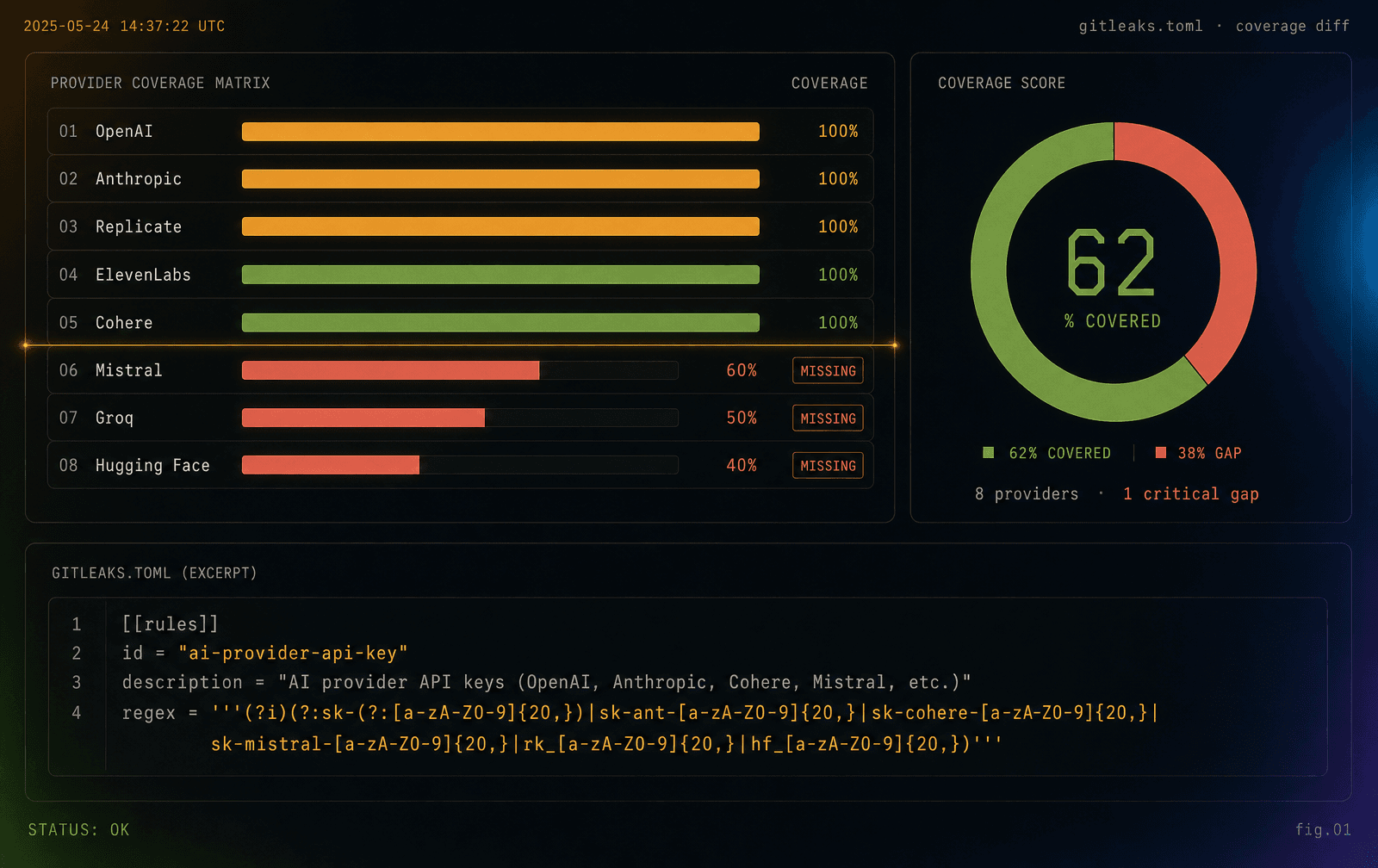
Curated patterns against a maintained checklist
Coverage rules are documented from each provider's real key format and unit-tested against live fixtures — not LLM-generated guesses. We use these keys ourselves, so missing patterns get caught against our own configs first.
- ✓Pattern set updated when vendors ship new formats
- ✓Every regex has a unit-tested fixture
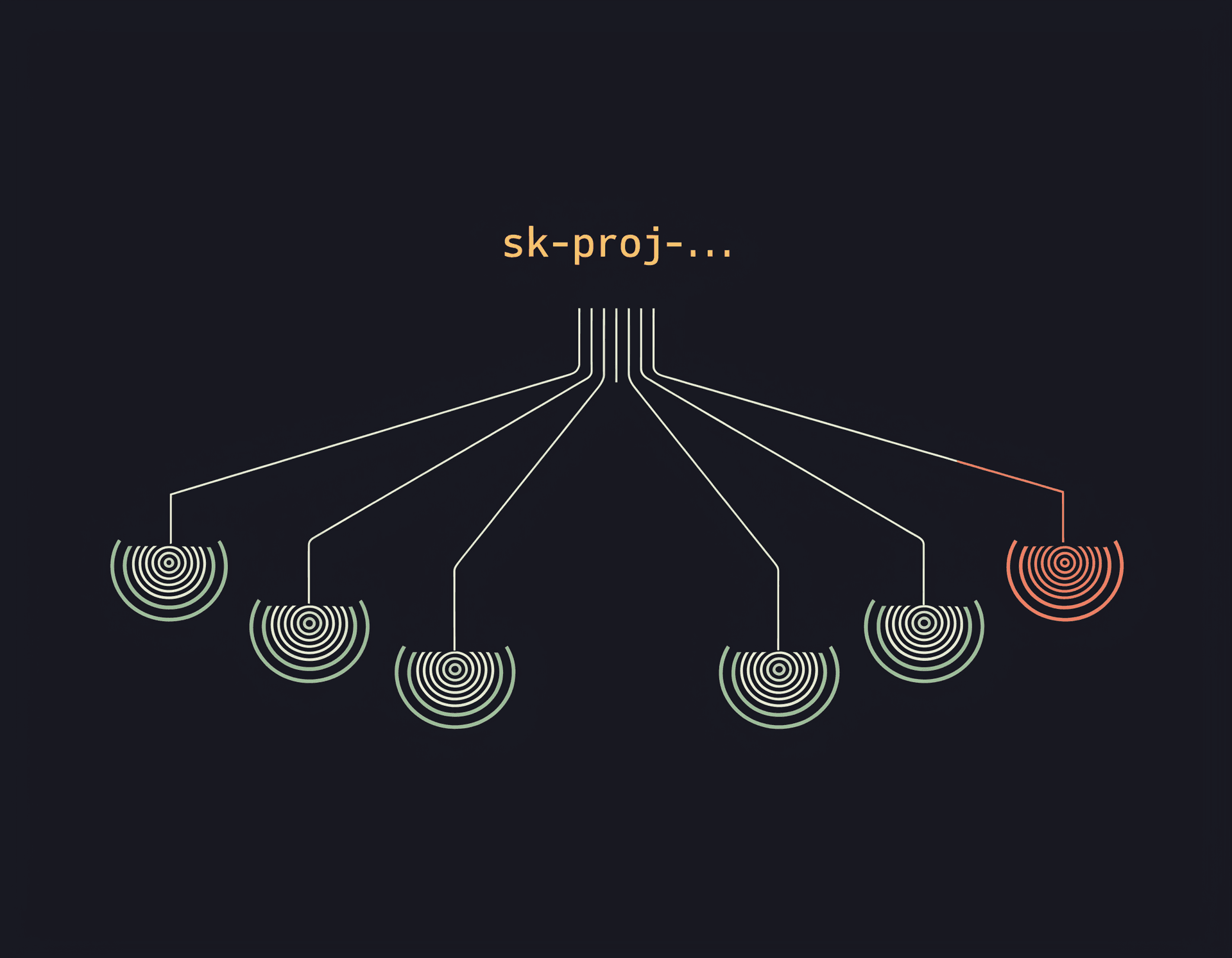
We use these keys ourselves. The library comes from reading provider docs and breaking our own keys — not from prompting an LLM.
You already know what happens when you ask GPT for “a regex matching OpenAI keys”: a confident-looking pattern that over-matches generic strings or misses the actual format. Every regex in our coverage library is documented from each provider's real key spec and unit-tested against a real fixture before it ships in your report.
Honest answers to the questions we hear most.
Still on the fence? Drop your question in the waitlist form above — a real person replies, usually within a day.
Doesn't my AppSec firm handle this?
Almost certainly not between engagements. Annual penetration tests and security reviews don't refresh scanner rule packs as new providers ship new key formats. ScanGap is the gap between those reviews — a point-in-time coverage audit you can hand back to them, or staple to a questionnaire.
Isn't GitGuardian free?
GitGuardian's free tier is excellent at what it does, but its public detector library is community-maintained and frequently lags behind new provider formats (Anthropic's 2026 key prefix, OpenAI's project keys, Mistral and Groq's launches). We audit whatever scanner you already run — including GitGuardian — against a current AI-provider pattern set.
What if my scanner config doesn't have AI-key rules at all?
That's the most common finding. The audit lists every provider you're missing alongside the exact rule blocks for your scanner — Gitleaks TOML, Semgrep YAML, or TruffleHog JSON — so you can paste them straight into your existing config. Same scanner, same workflow, just complete coverage.
What scanners do you support?
Gitleaks, TruffleHog, Semgrep, and GitHub Secret Scanning (custom patterns). If you run something else, reserve with a note and we'll confirm whether your config is supported before the launch email goes out.
Why $99 and not a subscription?
Because the audit is a discrete deliverable, not a tool. One report, one paste, done — no login, no monthly bill, no dashboard to babysit. Continuous monitoring exists as a separate $99/mo tier you can opt into on the reservation form if you'd rather subscribe than re-audit.
When does this launch?
ScanGap is in a 7-day private validation window right now. If reservations clear the threshold we set internally, we build the parser, pattern library, and automated report generator across the following two weeks — so the live checkout email lands ~2–3 weeks after you reserve. If we decide not to build, you get one short email saying so and your reservation is closed out. No card is taken either way until the live product ships.
Am I being charged today?
No. Reserving puts your work email on the launch list at the $99 price and fires a single intent signal we use to decide whether to build. No payment method is collected on this site. The first time a card is involved is the live checkout email we send when the audit goes live.
Your AppSec firm isn't tracking new API key formats
A point-in-time coverage audit you can attach to a security questionnaire or hand to your AppSec firm as scoped follow-up work.